Labs
Labs on carnivore: a useful panel, not a collection album
Which blood work makes sense on a carnivore pattern — thyroid, ferritin, kidney, lipids, inflammation — and what you should not titrate in a forum.
At a glance
- A useful panel is short, repeatable, and tied to a clinical question. It is not a 40-marker curiosity screen.
- Thyroid, iron status, kidney, and inflammation need context: symptoms, medications, training, a large meat meal before the draw.
- Reference intervals are population statistics. A deviation is not automatically disease, and extreme values are not ‘normal for carnivore.’
- Nobody should be titrating troponin, potassium, or extreme TSH in a forum.
A panel, not a collection album
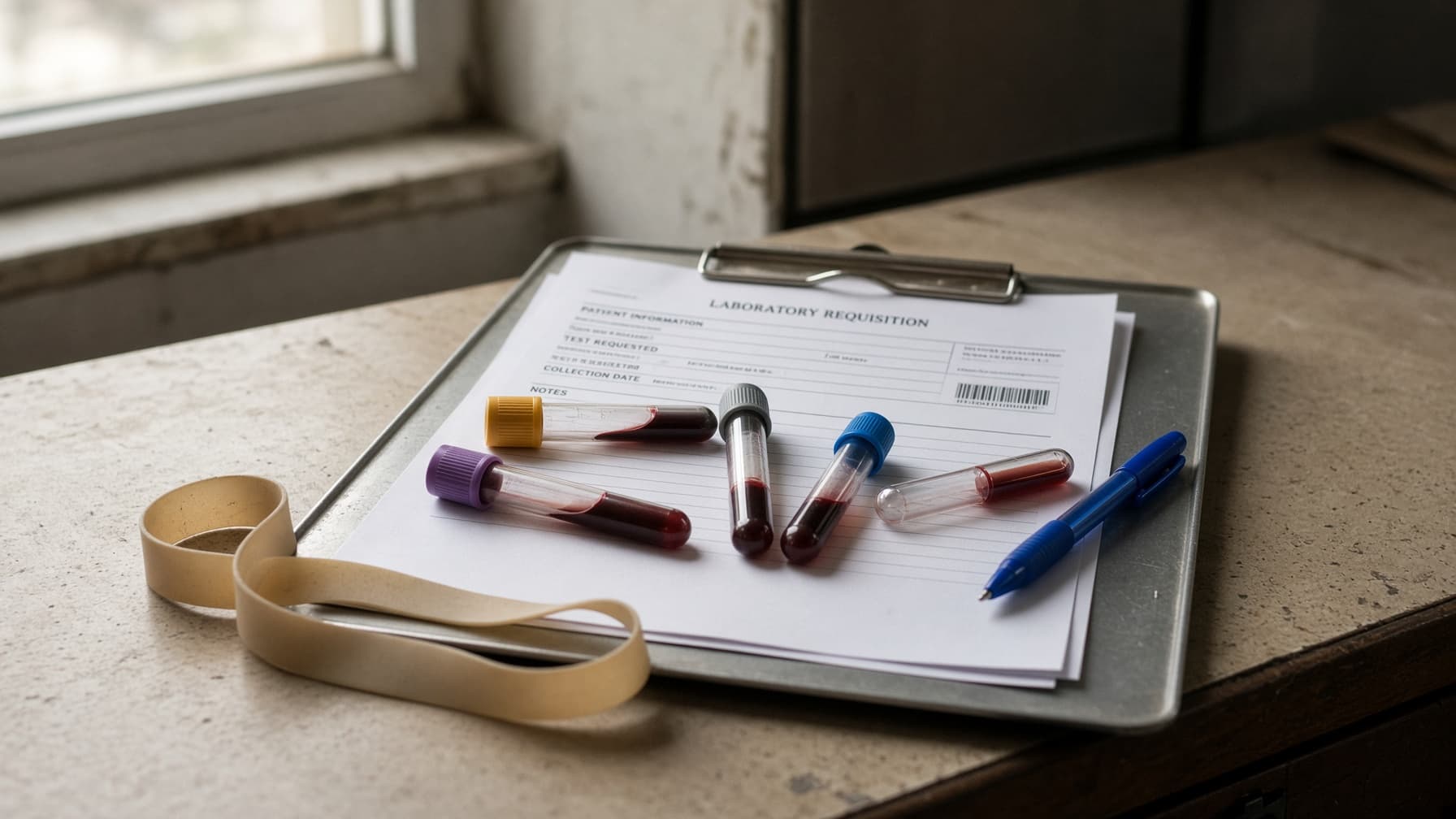
Labs are expensive, anxiety-laden, and useful. Use them badly and you get exactly that order. A good panel answers a question (“What does my iron status look like after a year of a lot of heme iron?”) and gets compared: to you six months ago, not to an influencer. There is a core panel and optional extras. How to read individual markers lives in the blood-work article. Lipids: ApoB/LDL.
Red flags on the printout
Very high or low potassium or sodium, an acute creatinine jump, extreme TSH, ferritin in the extremes plus symptoms, troponin, glucose off the rails: that is not self-interpretation. See red flags.
When to draw
Before you start, or in a stable omnivorous stretch, you get a baseline.
Week 2 is the wrong moment to treat labs as a success metric. Water, glycogen, calories, and sleep distort the picture in that phase.
After 8–12 weeks of a reasonably stable practice is a sensible time, or earlier if there are symptoms.
You draw fasted and hydrated, with no extreme training the day before, and no huge meat meal immediately before a kidney or creatinine draw if you actually care about that marker. In pregnancy, during lactation, in children, and in people with known disease, the panel belongs in the treating clinic.
Core panel (pragmatic)
The core includes a CBC, ferritin, and transferrin saturation or soluble transferrin receptor.
For metabolism: fasting glucose and HbA1c, with insulin optional.
For lipids: total cholesterol, HDL, LDL-C, and triglycerides, ideally with ApoB or non-HDL as well.
For thyroid: TSH and free T4, with free T3 if there is a reason.
For kidney: creatinine and eGFR, cystatin C if needed.
Electrolytes: sodium, potassium, magnesium. Liver enzymes and CRP/hsCRP depending on context.
Further reading
Sources
- CLSI / IFCC – concept of reference intervals (population-based, method-dependent)
- WHO – Haemoglobin concentrations for the diagnosis of anaemia (CBC context)
- Adams & Barton 2007 – Haemochromatosis (Lancet, PMID 18022044)
- Jonklaas et al. 2014 – Guidelines for the treatment of hypothyroidism (ATA, PMID 25266247)
- KDIGO – CKD evaluation and management (eGFR context, not a carnivore guideline)
- Ference et al. 2017 – ApoB and cardiovascular risk (PMID 28330828)
- Pearson et al. 2003 – Markers of inflammation and cardiovascular disease (AHA/CDC, PMID 12551878)
This content is general information. It is not medical, dietetic, or diagnostic advice.